|
 |
Most cross stitch designs are stitched exactly as described in the pattern instructions. You use the fabric suggested and follow the pattern key for how many strands to use with the various stitches. So it isn't unusual if you have already stitched several patterns before you encounter this topic. But sooner or later
- a pattern won't indicate the number of strands to use for each stitch type,
- you decide to use a different fabric count, or
- the floss color combined with fabric color results in too much of the fabric showing beneath the stitches.
More art than science
If you've spent much time on this website, you've probably read this before: Cross stitch is more art than science.
Although there is certainly a technical component to what we do, the bottom line is that YOU make the decisions that affect the quality and appearance of your final cross stitch piece. Ask yourself what you can do to make your cross stitching the best that it can be.
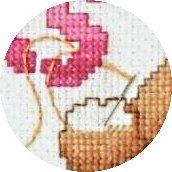
Don't use enough strands, and you'll notice that a lot of fabric is showing through the cross stitches. Imagine a painting where the artist leaves splotches of the underlying white canvas exposed.
Use too many strands for the fabric count you've chosen, it will be difficult to stitch. The thickness of the floss enlarges and emphasizes the holes. Your stitches look bulky and lose definition.
The decision's up to you!
No hard and fast rules exist for exactly how many strands of floss to use in all situations. I've seen a number of tables that propose how many strands should be used for each thread count. But many of those give conflicting information.
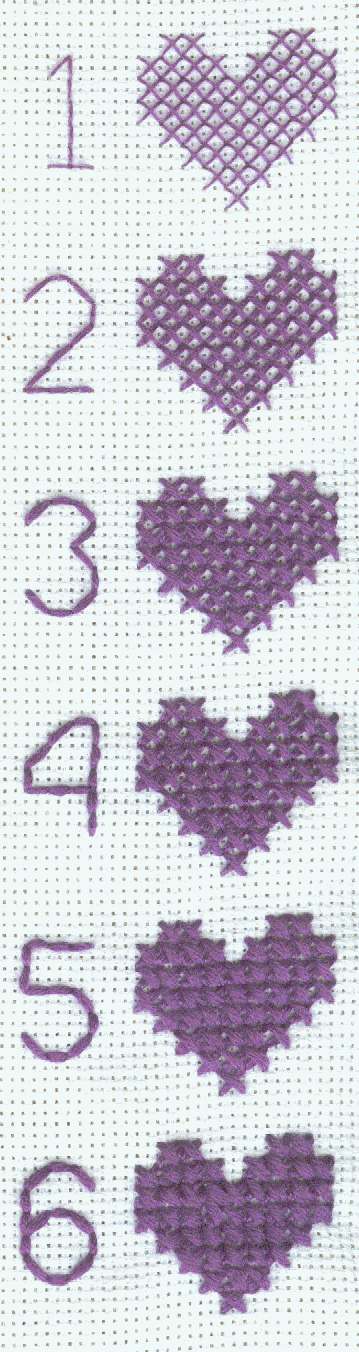
So, take a look at the examples below and decide for yourself. The photos are shown in the correct size relative to each other (except the one on red fabric farther below).
Thank you for your amazingly helpful and interesting site! I recently started cross stitching again after several years; I forgot a lot! I wanted to know how many threads to use when stitching on 11 count Aida. You didn't tell me, you let me decide by reviewing your examples. This is a wonderful teaching technique! Again, thank you! -- Rosalie
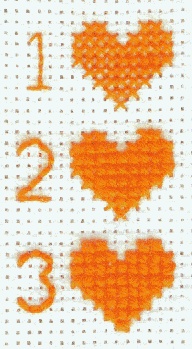
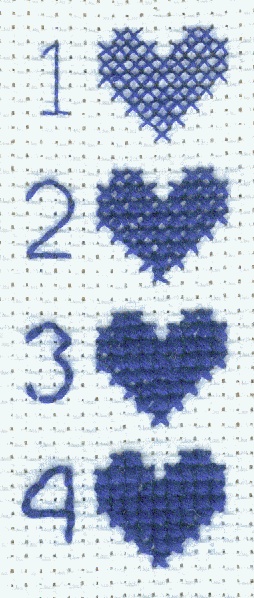
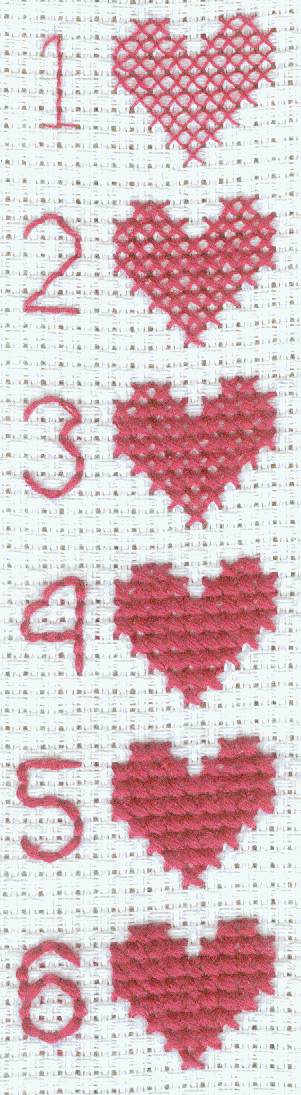
You'll see that the larger the fabric count number, the smaller the stitches. We've used Aida cloth for these examples: 18 count, 14 count and 11 count. The final column displays 18 count fabric with the cross stitches done over two threads, which is the equivalent of stitching on 9 count fabric.
The number beside each heart indicates the number of strands used. The number character itself was created with backstitches, also using that same number of strands.
To take a closer look, click on the label below each example.
A new tab will open with an ENLARGED VERSION of each example.
One more thing to consider
|
There is another factor that figures into
this equation: Fabric color. The photo to the right shows the affect of coverage and fabric color on how your eye sees the color of the floss. The more strands used, the more "yellow" it looks. This is the best argument for working stitches in the corner before deciding how many to use. |
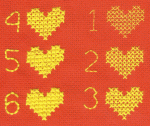 Floss Coverage on Dark Fabric Floss Coverage on Dark Fabric |
Substitute a different fabric color, and it may be necessary to make other adjustments:
- If the fabric is dark or bright, and the floss color is light, you may need to increase the number of strands to achieve full coverage
- If the fabric color is too close to the floss color, you may want to adjust the floss color to get more contrast between floss and fabric.
Again, there is no substitute for stitching a small area with a sample of each stitch type, using the floss colors you are uncertain about. This assures that your cross stitch piece turns out the way you expected.
Now you know what coverage means, why it matters, and best of all, that you are the final authority.
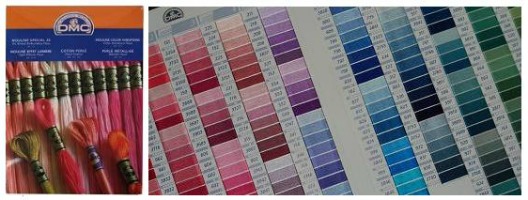 |
Need to make changes to the floss colors in your cross stitch pattern? A DMC Color Card is invaluable. You can read about in our Amazon Store. Click here and a new window will open. |
Home › How to Cross Stitch › Floss Coverage
Home › Getting Started › Floss Coverage
Blog


-
Fabric Mounts
Nov 25, 17 08:17 PM
I want to ditch my old split rail frames and stand. I have read about a new product called, Fabric Mounts. It is supposed to keep material taut and aligned -
Hoops are okay
Nov 25, 17 08:15 PM
I've tried them all . I prefer spring hoops but if my hands are weak I have a difficult time squeezing it. The tension is great if you like taut. I NEVER -
Why a hoop????
Nov 25, 17 08:14 PM
I have never used a hoop and have been cross-stitching for 15 years - only because I didn't think it appropriate. Suddenly I came across this article and -
Don't settle for "almost"
Apr 08, 17 01:16 AM
What do you do when you can't find the perfect cross stitch chart? It happens more than you'd think.
Even though we're no longer limited to the patterns we can find in magazines or at the local craft…